Start with the plant’s growth habit
A climbing houseplant can bring greenery upward without taking much floor space. Before adding a stake, look at how your plant grows. Pothos and many climbing philodendrons produce long vines with leaves and nodes spaced along the stem. Some monsteras develop thicker stems and aerial roots that benefit from a sturdier support. A trailing plant may not need to climb at all; training it upward is a choice about the shape you want and the space available.
Find the main stems and the direction of their newest growth. The small points where leaves and roots emerge are nodes; they are useful landmarks when positioning a vine. Leaf stalks, called petioles, need room to move and should not be tied against a support. If a stem has been hanging for a long time, guide it gradually rather than forcing a sharp bend. Brittle or woody sections may not change direction easily.
Choose a support that fits the plant and the room
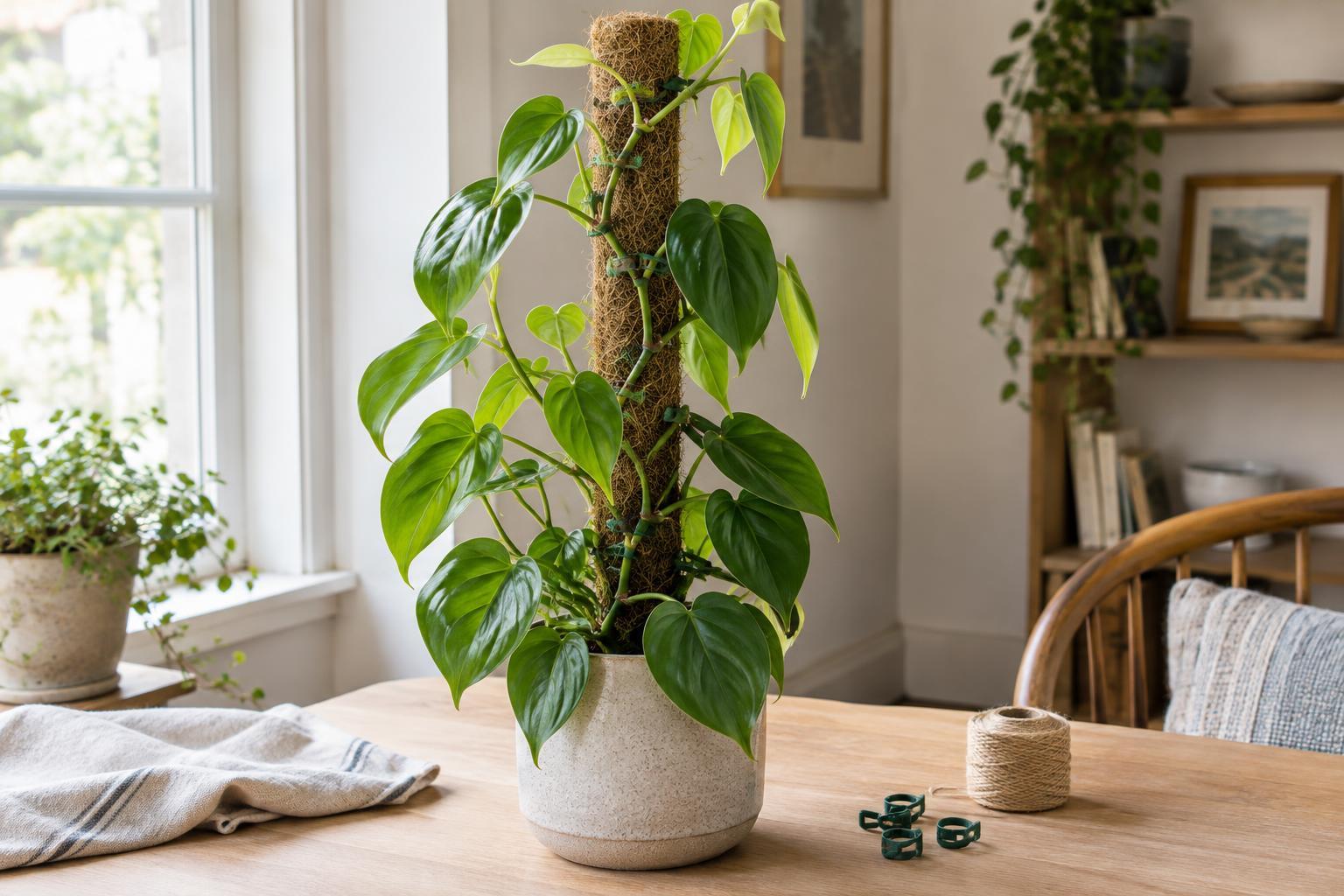
A simple stake works well for a young vine that only needs a little guidance. A trellis offers several routes for flexible stems and can create a wider, leafy shape. A moss or coir pole gives aerial roots a textured surface to grow toward, though contact does not guarantee that every root will attach. For a large plant, choose a support sturdy enough to carry its future growth, not just its current height.
Think about access as well as appearance. Leave enough room to turn the pot, water the soil, and inspect leaves. A narrow support can keep a plant close to a wall, while a broader trellis can help fill an empty window-side corner. Whatever you choose, check that it has no sharp edges where stems will rest. If the pot is light or the plant is top-heavy, a tall pole may make the whole arrangement unstable.
Install the support and attach stems gently
It is often easiest to add a support while repotting, when you can see where the roots are and set the base deep enough to stand firmly. If you are keeping the plant in its current pot, insert the support slowly near the edge or behind the main stems. Stop and reposition it if you meet strong resistance; pushing through the root ball can damage roots. Firm the potting mix around the base and test whether the support wobbles before attaching the plant.
Bring each stem toward the support in a natural curve. Use soft plant ties, reusable hook-and-loop tape, or loose loops of cotton string to hold it in place. Fasten the stem itself, preferably near a node, rather than binding a leaf or petiole. Leave a little space inside each tie for growth, and use several gentle attachment points instead of one tight one. On a pole, position aerial roots toward the surface where possible, without trying to tuck or pull them into place.
Guide new growth into the shape you want
Training is an ongoing task, not a one-day fix. Check the plant every few weeks during active growth and guide flexible new sections before they travel far beyond the support. You might wind a vine loosely around a trellis, direct several stems up separate sides of a pole, or keep one main stem upright and let shorter growth spread outward. Avoid wrapping vines so tightly that you cannot remove or adjust them later.
If a stem has grown too long for the space, pruning can make the arrangement easier to manage. Cut with clean scissors just above a node on the part of the plant you are keeping, then reassess where the remaining stems need support. You can also leave some vines trailing for a softer outline. The aim is not perfect symmetry: it is a shape that lets the leaves receive light and gives you room to care for the plant.
Keep the support working as the plant grows
Inspect ties as stems thicken, and loosen or replace any that begin to press into the plant. Check that the support remains steady after watering and that new growth has not become tangled around nearby furniture. If you use a pole designed to be kept moist, follow its care needs without soaking the potting mix simply to wet the pole. The plant’s roots in the pot still need watering suited to the species, light, and conditions in your home.
Eventually, a plant may outgrow its first stake. Extend or replace the support when it becomes crowded or unstable, ideally during a planned repot. With a secure base and a few small adjustments over time, you can encourage a climbing houseplant to grow upward while keeping its stems, leaves, and roots easy to see and care for.