Start with the spot, not the room
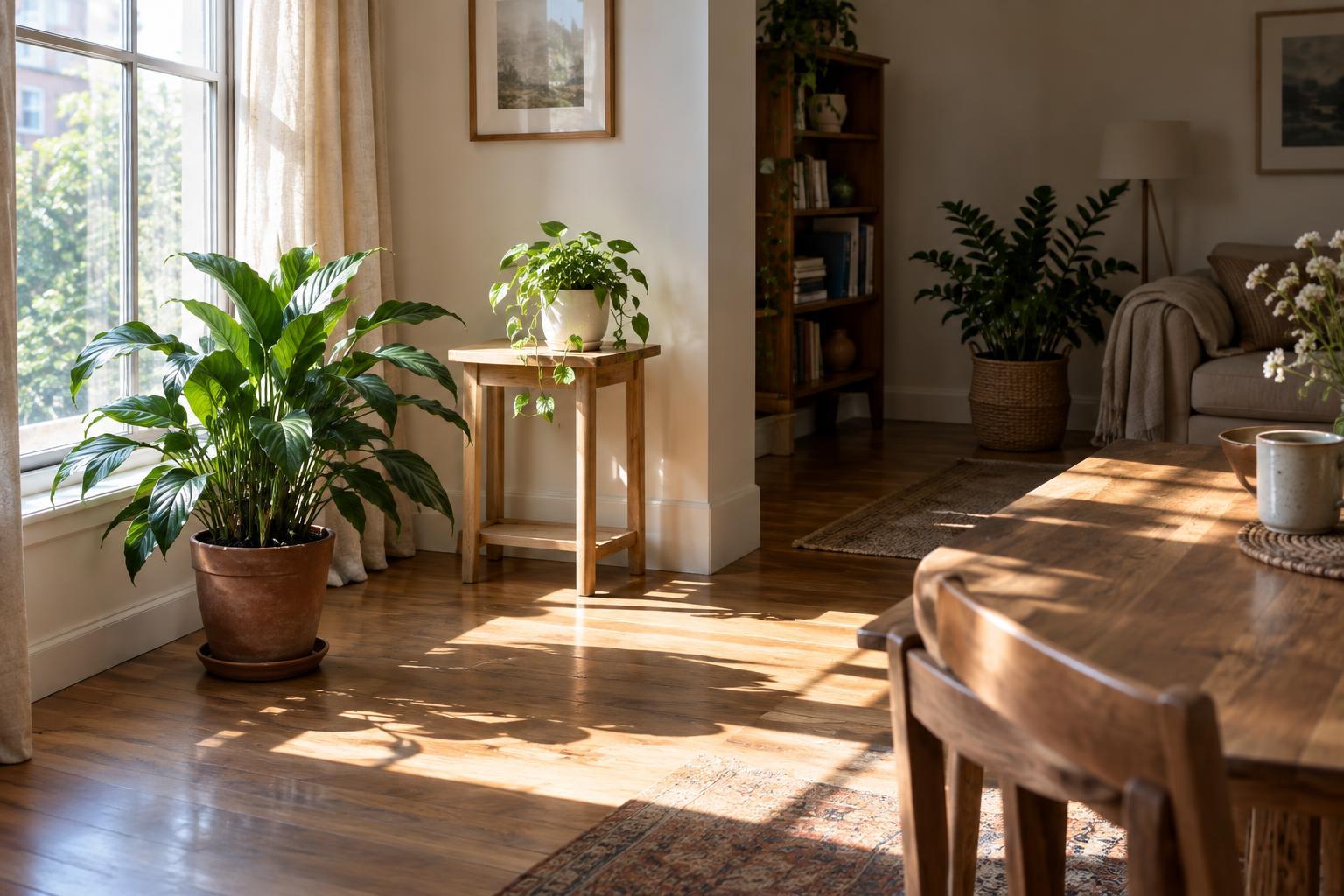
Calling a room “bright” can be misleading. A plant on the windowsill may receive direct sun while one on a shelf across the same room gets little usable daylight. To assess light, look at the exact place where the leaves will sit. A tall plant on the floor, a hanging plant near the glass and a small pot tucked beside a bookcase can each experience different conditions.
Begin by checking whether sunlight falls directly on that spot. Direct light casts a distinct shadow and may form a patch of sun on the floor or leaves. Bright indirect light illuminates a space without a sunbeam landing on the plant. Low light is a dimmer position away from the window or behind an obstruction; it does not mean no light. These descriptions are more useful for placement than a room name alone.
Watch the light move through the day
Choose an ordinary day when you are home and check each potential plant spot in the morning, around midday and later in the afternoon. Note when direct sun reaches it, when it is brightly lit without direct sun and when it falls into shade. A quick sketch of the room with these observations is enough; there is no need to measure every hour.
Window direction offers a starting clue, but it is not a complete answer. Depending on where you live, one side of a home may receive stronger sun than another, and morning sun often feels gentler than sun arriving during the hottest part of the day. Nearby buildings, balconies, roof overhangs, trees and even a deep window recess can change what reaches a plant. Look at the actual light rather than relying only on the direction the window faces.
Pay attention to distance, too. Daylight can fall off noticeably as you move away from a window, especially in a narrow room or one with small windows. If you want a plant on a console or high shelf, assess that surface directly instead of assuming it has the same light as the nearby sill.
Make a simple light map for each room
Divide each room into a few practical zones: places that receive direct sun, places with bright indirect light and places that stay relatively dim. Record useful details beside each zone, such as “sun until late morning” or “bright, but shaded by the porch.” Repeat the check on both a clear and an overcast day if you can. Cloud cover changes the amount of light, but the comparison can still help you understand which spots are consistently brighter.
Walk through the home with your usual curtains, blinds and doors in their normal positions. A south-facing window behind a closed blind may provide less light to a plant than a less sunny window left uncovered. If you routinely draw curtains for privacy or heat, plan around that habit rather than an idealized version of the room. Also consider whether a nearby chair, cabinet or newly grown tree foliage will shade a proposed spot.
Account for seasonal changes
A good plant position may not stay identical all year. The sun’s path changes with the seasons, and deciduous trees can provide shade when leafy and allow more light through when bare. In some rooms, a sunbeam that never reaches a plant in one season may fall directly onto its leaves in another. Revisit your light map when days begin to feel noticeably longer or shorter, and after moving furniture or changing window coverings.
You do not need to keep every plant in one permanent place. A small move closer to a window may help a plant in a dimmer period, while shifting it out of a strong sunbeam can protect leaves that prefer indirect light. Make changes gradually where possible, particularly when introducing a plant to direct sun. Sudden exposure can be harder on foliage accustomed to a shadier spot.
Use the map, then let the plant guide you
Compare your mapped spots with the light guidance for each plant. A plant described as preferring bright indirect light is a better candidate for a position beside a sunny window or just outside the path of a sunbeam than for a dark corner. A plant that tolerates lower light may suit a spot farther into the room, though growth may be slower there. No houseplant can make use of a space with no meaningful light.
After placing a plant, watch its new growth over several weeks. Stems stretching toward the window, unusually long gaps between leaves or declining growth can suggest that it needs more light, although watering and other conditions may also play a part. Pale or scorched patches on leaves that face the glass can suggest too much direct sun. Change one thing at a time, such as moving the pot a little closer or farther away, so you can judge whether the new position helps.
Treat your light map as a working note, not a rigid rule. The aim is to notice how your home behaves and give each plant a reasonable starting place. Once you know where sun lands, where daylight stays soft and which corners remain dim, choosing and arranging indoor greenery becomes much less of a guess.